
Hot rounds expose every weak link in your kit, and the fastest way to feel miserable is choosing the wrong best material for golf shorts. When fabric traps heat, sweat sticks to your skin, and seams start to rub, your attention moves from club selection to pure discomfort.
Most problems come from three things:
-
Sweat that cannot move (cling, damp spots, slow drying).
-
Friction in motion (inner-thigh chafe, waistband pinch, pocket bulk).
-
Heat that cannot escape (heavy fabric, dense weave, poor airflow).
This ultimate guide breaks the topic down in a practical order: fabric science first, then real on-course decision-making. You will learn how breathability, Moisture-wicking, stretch, and fabric weight work together. You will also see how modern Performance Activewear design details can keep you cooler from the first tee to the last putt.
Finally, you will see how PULI designs golf-ready hybrids that balance clean looks with heat-ready performance, including a lightweight polyester-spandex build and pocket layouts that stay usable while you walk.

Official Site: PULI
Core Foundations
Breathability: airflow, porosity, and heat release
Breathability is how easily air moves through a fabric so body heat can escape. In practice, you feel it as less "steam" trapped at the waistband and less sweaty stickiness behind the knees.
Several factors control breathability:
- Yarn and weave density: tighter fabrics block airflow but can feel smoother.
- Surface area: textured weaves can increase evaporation by spreading moisture.
- Garment design: vents and room in the thigh create a small air pump as you walk.
A simple rule helps: if a short feels great standing still but turns clammy after three holes, the fabric or the cut is not moving heat away fast enough.
Moisture-wicking: capillary action and evaporation speed
Moisture-wicking is a fabric system that pulls sweat off your skin and spreads it across a larger surface so it can evaporate faster. Many modern golf shorts use hydrophobic fibers (common in polyester and nylon) that do not absorb much water, so moisture stays mobile instead of soaking in.
To judge wicking in real life, check two things:
- Inner face feel: it should feel smooth and "dry" quickly after you stop.
- Dry-down time: damp areas should fade during a short walk, not linger.
When the wicking system works, you get less cling, fewer visible sweat marks, and a cooler feel during pauses on tees.
Stretch: elastane percentage, recovery, and mobility
Stretch is not just about comfort. On a golf swing, your hips rotate and your trail leg loads. Without stretch, fabric pulls at the seat and thigh, which can subtly change posture.
Key stretch terms:
- Elastane/spandex content: small percentages can create big movement gains.
- Two-way vs. four-way stretch: four-way typically feels more natural during rotation.
- Recovery: the fabric returns to shape after walking and sitting.
A short can feel "stretchy" at first but still bag out after nine holes. Recovery matters as much as stretch.
Weight: gsm, weave density, and drape
Fabric weight is often described as GSM (grams per square meter). Lower GSM can feel cooler, but weight alone is not enough. A light fabric with a dense weave can still trap heat, while a slightly heavier fabric with better airflow can feel cooler.
Use weight as a decision filter:
- Hot and humid: prioritize light, fast-drying blends.
- Hot and dry: breathability and sun coverage matter most.
- Windy coastal: slightly more structure can reduce flapping and distraction.
As NASA confirmed after analyzing global temperature records, recent years have set new heat benchmarks, including 2024 as the warmest year on record. That trend raises the value of clothing systems that manage heat and sweat instead of fighting them. According to NASA, 2024 temperatures set a new record in the modern dataset.
Fabric Materials For Hot Rounds
What fabrics actually feel cooler on the course
When golfers ask about the best material for golf shorts, they usually mean: "What stays comfortable after 3-4 hours of sun, sweat, and walking?" The most consistent answers come from performance blends built around polyester or nylon, usually with elastane.
Typical fabric families you will see:
- Polyester blends: common in Performance Activewear because they dry fast and resist wrinkles.
- Nylon/polyamide blends: often feel slightly smoother and can be very durable.
- Cotton blends: can feel soft at first, but humidity and sweat can turn that softness into cling.
A practical way to choose is to match fiber behavior to your climate:
- In humidity, avoid fabrics that hold water, because that creates a wet layer that blocks cooling.
- In dry heat, fast evaporation is still important, but airflow and coverage become just as critical.
Why hydrophobic fibers help in heat
Most "cooling" golf shorts do not magically lower your temperature. Instead, they manage sweat so your body can cool itself. Hydrophobic fibers do not absorb much moisture, so sweat stays on the surface where air and movement can evaporate it.
This matters because evaporation is your main cooling engine during a round. When sweat spreads and dries efficiently, you get:
- Less fabric cling at the seat and thighs.
- Less friction and fewer hot spots.
- More stable comfort when you move from shade to direct sun.
PULI example: a heat-ready blend for walking rounds
PULI designs golf-meets-outdoor hybrids that fit into an Athleisure wardrobe without looking like gym shorts. A good example is the PULI Men’s 12" Inseam Golf Hiking Shorts, built with 96% polyester and 4% spandex and a below-knee 12-inch inseam for added coverage. The product listing highlights moisture-wicking durability and a pocket system built for active use.
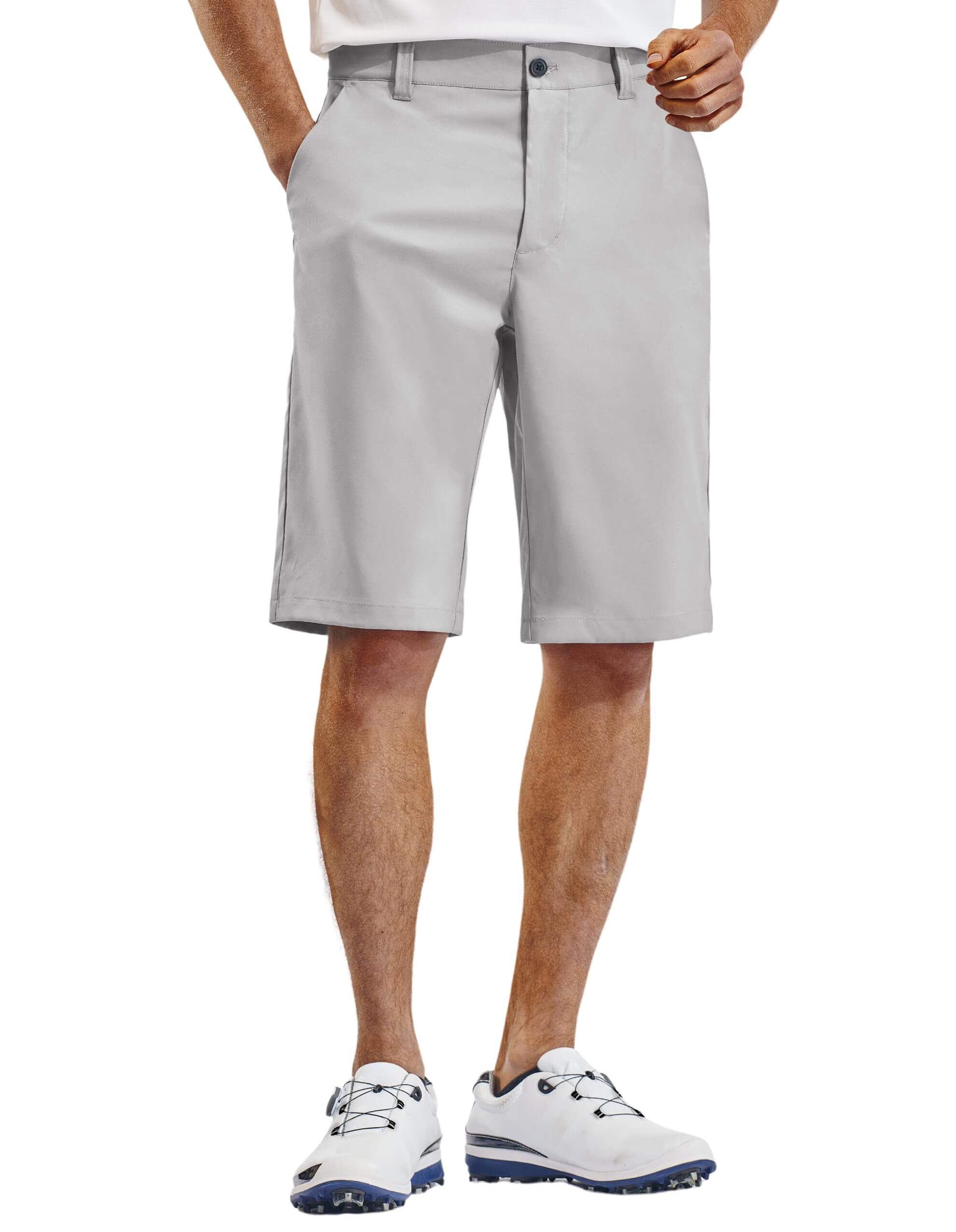
The practical takeaway is not the percentage by itself. It is the combination of:
- A fast-drying base fiber (polyester).
- Added stretch for rotation and stride.
- A longer inseam that can reduce inner-thigh seam drift while walking.
Performance Metrics And Test Standards
Why performance claims need a shared yardstick
Words like breathable, quick-dry, and Moisture-wicking show up everywhere. The challenge is that two fabrics can both claim "breathable" while behaving very differently on a hot back nine.
A simple framework helps you read claims:
- Breathability: how much air passes through.
- Moisture transport: how quickly sweat moves and spreads.
- Drying: how quickly the fabric returns to a dry feel.
If you cannot test fabric yourself, lean on construction signals:
- visible stretch content,
- a smoother inner face,
- and lighter, less dense handfeel.
Air permeability and why it matters
Air permeability is one of the cleanest proxies for cooling potential. It captures how easily air can flow through a fabric structure. One widely used lab approach is the ASTM D737 method, which standardizes how air flow is measured through textiles so results can be compared across materials.
The benefit of standardized testing is comparability. When brands use a consistent method, you can better interpret whether a fabric is built for airflow or built mainly for structure.
Moisture management methods and wicking visualization
Wicking is tricky because moisture behavior changes with pressure, temperature, and fabric layers. That is why imaging-based approaches have grown in value. In 2025, AATCC released Test Method 217, an imaging analysis method focused on moisture management behavior in textiles. According to INDA, AATCC TM217 centers on imaging analysis for moisture management, which helps characterize how fabrics move liquid across surfaces.
From a golfer perspective, the lab details matter less than the outcome:
- Does the fabric spread sweat quickly?
- Does it stop feeling wet during a normal walk?
- Does it avoid sticking when you sit in a cart seat?
Design Features That Increase Cooling
Inseam length: cooling vs. coverage trade-offs
Inseam choice changes cooling more than many golfers expect. Shorter inseams can expose more skin and reduce fabric contact, which can feel cooler. However, longer inseams can reduce chafe for walkers by keeping seams stable and reducing inner-thigh friction.
Use this decision rule:
- Cart-heavy rounds: you can often go shorter for airflow.
- Walking 18 holes: choose the inseam that prevents thigh rub first, then optimize airflow.
A 12-inch inseam, like PULI’s below-knee style, can be a comfort upgrade for golfers who chafe during long summer walks.
Pocket layout: storage that does not overheat you
Pockets affect cooling because bulky pocket bags increase fabric layers and reduce airflow where you sweat most. They can also create pressure points that trap moisture.
Look for:
- Flat front pockets that do not balloon.
- Secure pocket options so you carry less in loose stacks.
- Placement that stays stable during the swing.
The PULI Men’s 12" Inseam Golf Hiking Shorts listing describes five pockets (two front, two back, and one hidden phone pocket). That setup helps you separate items so you do not stack phone, tees, and wallet into one sweaty pocket zone.
Waistband engineering: comfort without heat buildup
A waistband can either ventilate and move with you, or it can trap heat and create friction. When a waistband pinches, sweat accumulates faster because air cannot circulate.
Prioritize:
- a smooth inner waistband,
- enough give for a full rotation,
- and belt loops that do not create stiff pressure ridges.
Fabric contact points: fewer hot spots, less cling
Cooling improves when you reduce continuous contact. Designers can do this by:
- creating slight room at the thigh,
- using stretch to prevent binding,
- and minimizing bulky seam overlaps.
In practice, the "coolest" shorts are often the ones you forget you are wearing.
Fit, Movement, And Swing Comfort
Why fit is part of the best material for golf shorts
Two golfers can wear the same fabric and get different results because fit changes airflow and friction. If shorts are tight at the thigh, sweat has nowhere to go and the fabric stays glued to your skin.
Fit is a system with four checkpoints:
- Rise: affects how the waistband sits during rotation.
- Seat: affects pull across the glutes at the top of the backswing.
- Thigh room: affects airflow and chafe.
- Hem opening: affects ventilation and mobility.
A helpful sign is how the short behaves when you step onto a tee box and widen your stance. If the fabric pulls hard at the seat, you will fight it for 18 holes.
Stretch and rotation mechanics
Golf rotation includes pelvis turn, trunk turn, and lateral weight shift. Stretch fabrics support this by allowing micro-movements without resisting. Even a small elastane content can reduce waistband pressure during the transition and follow-through.
Four-way stretch also supports walking comfort:
- less tug at the seat on uphill lies,
- fewer seam shifts at the inner thigh,
- and less need to constantly adjust the hem.
Balancing Athleisure style with course utility
Modern Athleisure shorts succeed when they blend:
- a clean, chino-like look,
- hidden performance features,
- and an easy transition to post-round wear.
This is where hybrid shorts shine. You get the look that fits a clubhouse, but the fabric behavior of Performance Activewear.
Sweat Management For Humid Conditions
Humidity changes the rules
Humidity reduces evaporation speed because the air already holds a lot of moisture. That means sweat can stay on your skin longer, which increases cling and chafe.
In humid conditions, your priorities should shift:
- Moisture-wicking inner face (move sweat off skin first).
- Fast dry-down (reduce wet fabric time).
- Low friction (reduce rubbing while damp).
Anti-cling layering strategy
Shorts are only half the system. In humidity, consider what is touching your skin.
Practical options:
- Choose a fabric with a smooth inner face that does not grab when damp.
- If you are a high-sweat walker, consider lightweight base layers designed to reduce friction.
- Avoid thick pocket loading that presses wet fabric into your thigh.
A field test you can do on your own
You do not need a lab to compare two shorts. Use a simple repeatable test:
- Wear each short for a 20-minute brisk walk.
- Sit for 5 minutes.
- Stand and walk again.
The better summer short will:
- stop feeling damp quickly,
- avoid sticking after sitting,
- and keep the inner thigh from feeling "tacky."
NOAA climate reporting shows sustained warmth trends in the U.S. In its annual 2025 assessment, NOAA noted that the contiguous U.S. averaged 54.6F in 2025, ranking as the fourth-warmest year in the 131-year record. According to NOAA NCEI, persistent above-average temperatures increase the need for practical heat-management choices in everyday outdoor activities.
Selection And Decision Guide
Climate: heat index and airflow priorities
For the best material for golf shorts, climate is the first filter.
Match to conditions:
- Hot and humid: prioritize Moisture-wicking and quick dry over "soft" feel.
- Hot and dry: prioritize breathability and sun coverage.
- Variable weather: look for water resistance and fast recovery after dampness.
If you regularly feel sticky behind the knees, you likely need higher airflow or less dense fabric.
Activity: walking vs. cart and why it changes everything
Walking creates constant friction and constant heat output. Cart rounds create heat spikes and long seated periods.
Choose based on your round type:
- Walking 18: stretch, stable inseam, and chafe control come first.
- Mostly cart: faster dry-down after sitting and smoother seat fabric matter most.
Hybrid shorts with multiple pockets help walkers because they keep items distributed, reducing pressure points.
Feel: Athleisure handfeel vs. structured chino feel
Golf shorts sit on a style spectrum:
- Athleisure feel: softer, often more knit-like, very easy movement.
- Chino feel: more structured, often woven, cleaner drape.
Many golfers want a woven look with Performance Activewear behavior. In that case, prioritize a woven polyester (or polyamide) blend with elastane and a smooth inner face.
Function: pockets, belt loops, and course utility
Cooling is not only fabric. Utility features keep you from carrying extra gear in awkward ways.
Check these details:
- pocket depth that holds a phone without bouncing,
- at least one secure pocket for keys,
- belt loops that do not dig,
- and pocket bags that do not add bulk.
Quick decision table
| Scenario | Key cooling risks | Material and build priorities | Practical trade-offs |
|---|---|---|---|
| Hot, humid walking round | cling, chafe, slow drying | Moisture-wicking, quick dry, stretch recovery | may feel more "technical" than cotton |
| Hot, dry desert round | overheating, sun exposure | breathability, lightweight weave, coverage | very light fabric can feel less structured |
| Cart-heavy summer rounds | sticky seat after sitting | smooth inner face, fast dry-down | shorter inseam can ride up if too tight |
| Travel golf (packable) | wrinkles, inconsistent comfort | polyester blend, easy care, stretch | some fabrics feel less natural than cotton |
Best Practices And Pitfalls
Best Practices
- Choose lightweight performance blends for peak heat. Polyester or polyamide with elastane tends to outperform cotton in sweat management during long rounds.
- Prioritize a Moisture-wicking inner face. The layer touching skin matters most. If it stays wet, everything else feels hot.
- Confirm stretch recovery after washing. A short that bags out will reduce airflow in the wrong places and increase friction in others.
- Manage pocket bulk deliberately. Spread gear across pockets, or carry less. Thick pocket stacks turn into heat-and-friction zones.
- Treat golf shorts like a system. Pair them with a breathable belt, a light polo, and socks that do not trap sweat.
Common Pitfalls to Avoid
- Picking heavy cotton for humidity. Cotton can feel cool at first but often holds moisture, which increases cling and can raise friction over time.
- Ignoring pocket placement and chafe. Even great fabric can feel awful if a pocket seam sits on your stride line.
- Buying tight thighs for walking comfort. Tight shorts reduce airflow and increase rubbing. If you walk most rounds, thigh room is not optional.
- Assuming "quick dry" means "cool." Some dense, water-resistant fabrics shed water but still trap heat if airflow is low.
- Over-optimizing one feature. Maximum stretch without structure can feel sloppy. Maximum structure without airflow can feel hot. Balance wins.
Conclusion
The best material for golf shorts is the one that lets your body cool itself: it breathes, it supports Moisture-wicking, it dries fast, and it moves with your swing. Fabric choice matters, but design details like inseam, pocket bulk, and waistband comfort often decide whether you stay focused on golf or on discomfort.
If you play in high heat, start with a performance blend that includes stretch, then match fit and features to your round style. When those pieces align, your shorts stop being a distraction and start acting like true Performance Activewear built for the course.
FAQ
What is the best material for golf shorts in extreme heat?
Polyester or polyamide blends with elastane usually perform best because they dry quickly and keep sweat moving. In extreme heat, evaporation is your main cooling tool, so fabrics that spread moisture and release it fast feel cooler. A smooth inner face also matters because it reduces cling when you sweat. If you walk most rounds, choose a material with reliable stretch recovery so the fit stays stable over 18 holes.
Are cotton golf shorts good for summer golf?
Cotton can feel soft and airy at first, especially in dry heat. However, cotton often absorbs sweat and holds it, which can increase cling and friction during long rounds. In humid weather, that slower drying can make you feel hotter over time. A cotton blend with added stretch can improve movement, but it still tends to dry slower than performance blends.
How much stretch should golf shorts have for a full swing?
Most golfers do well with shorts that include a small elastane content because it supports hip rotation and stride comfort. The goal is not maximum stretch, but controlled stretch with good recovery so the waistband and seat do not deform. If the fabric pulls across the seat at the top of the backswing, you likely need more stretch or more room. A quick test is a deep squat and a practice swing, which should feel smooth with no binding.
Why do my golf shorts stick to my legs when I sweat?
Sticking usually happens when sweat stays trapped at the skin or when the fabric absorbs moisture and stays wet. Tight thigh fit makes it worse because it removes airflow and increases contact area. A smoother inner fabric surface can reduce tacky friction during humid rounds. You can also reduce sticking by minimizing pocket bulk that presses wet fabric into your thigh.
Should I choose shorter or longer inseams for staying cool?
Shorter inseams can feel cooler because they reduce fabric contact and expose more skin to airflow. Longer inseams can be cooler for walkers if they prevent inner-thigh chafe and keep seams from drifting. The best choice depends on whether your discomfort comes from heat buildup or friction. If you chafe when walking, solving friction first often makes you feel cooler overall.
What features matter most in Performance Activewear golf shorts?
Start with moisture management and breathability because they determine how the fabric behaves under sweat. Next, evaluate stretch and recovery because they control swing comfort and fit stability. Then look at pocket layout, because bulky pocket bags can reduce airflow and create pressure hot spots. Finally, confirm the waistband feels comfortable during rotation and does not trap heat at the midsection.
How can I tell if a pair of shorts is truly moisture-wicking?
A true moisture-wicking fabric usually feels less wet against your skin because it moves liquid away and spreads it out. After a short walk, the damp feeling should reduce quickly once you stop sweating hard. If the fabric stays heavy, dark, or sticky for a long time, the moisture is not moving efficiently. You can compare two shorts by repeating the same 20-minute walk test and checking which one returns to a dry feel faster.
Can Athleisure golf shorts still look appropriate on-course?
Yes, if the shorts balance a clean silhouette with technical fabric behavior. Look for a structured waistband, a tidy front, and pockets that do not balloon. Many modern Athleisure designs use woven performance fabrics so they resemble chinos while acting like Performance Activewear. The key is choosing a fit that stays neat when you walk, sit, and swing.