
Still fighting a sticky waistband on the humid back nine, then spending the next few holes tugging fabric off your thighs? That small distraction can snowball into rushed pre-shot routines, swing tension, and even heat rash or chafing that lingers long after the round.
This guide breaks down what actually keeps golf shorts durable and comfortable in hot weather: airflow and dry time, seam strength, stretch placement, and pocket stability. You will also see how details like an engineered stretch waistband, a secure phone pocket, and the right inseam length change how you move when you walk 18. Start with the fundamentals, then use the modules and the decision framework to pick a pair confidently for your climate and your play style.
Official Site: PULI
Golf Shorts Fundamentals: Hot-Weather Comfort and Durability
Hot-weather comfort is mostly airflow plus dry time
When you shop Athleisure or Performance Wear for summer golf, focus on how fast the fabric stops feeling wet, not just whether it claims Moisture-Wicking. In real rounds, sweat collects at the waistband, inner thigh, and pocket bags. If that moisture stays trapped, friction rises and the shorts begin to cling during your walk and your rotation.
A practical way to evaluate comfort is to think in two layers:
- Skin side: smooth handfeel, low cling
- Air side: fabric that releases heat
Humidity matters because sweat cools you only when it evaporates. The National Weather Service explains that higher relative humidity hinders evaporation, which is why the heat index (how hot it feels) rises as humidity rises. It also notes that heat index values assume shade, and direct sun can increase the feels-like temperature by up to 15 F. This is exactly why golf shorts that dry quickly and do not trap sweat at the waistband feel noticeably better over 18 holes. According to the National Weather Service, the heat index combines air temperature and humidity, and full sunshine can raise the apparent temperature.
Durability is about weave, stretch recovery, and seam engineering
Most golf shorts do not fail because the fabric is too thin. They fail because stress concentrates at predictable points: pocket openings, belt loops, the seat when you squat to read a putt, and the inside leg seam when you walk.
To judge durability without laboratory tools, look for:
- Tighter weaves or structured knits (better snag resistance)
- Reinforced seams at high-stress zones
- Stretch that rebounds (so knees and seat do not bag out)
If you play early mornings (dew) and late afternoons (cart path grit), abrasion is constant. Shorts that feel airy can still be durable if the yarns are strong and the seams are clean. That is why a polyester-spandex blend can work well in hot weather: polyester brings strength and faster drying, while a small percentage of spandex supports mobility.
Mobility comes from where stretch sits, not just how much stretch exists
For golf, mobility is a three-part system: waistband stability, hip rotation space, and stride comfort. A short can be stretchy yet still restrictive if it is cut tight through the seat or if the rise pulls when you hinge at address.
Before you buy, do two movements in the fitting room:
- Golf hinge: hands to knees, then stand tall
- Long stride: simulate stepping over a push cart wheel
If the waistband slides down during either motion, you will keep adjusting it all round. If the fabric pulls across the front hip crease, you will feel it at the top of the backswing. A gusset can help, but so can a good pattern with enough room in the right places.
Utility is pocket security and carry layout, not pocket count
On hot days, you typically carry less, but you still need stable storage: phone, glove, a couple tees, maybe a ball marker. Poor pocket design creates two problems: bouncing weight while walking, and pocket bags that trap sweat.
A strong pocket system for golf usually includes:
- Deep front pockets that do not spill on a cart seat
- At least one secure pocket (zipper is ideal)
- Back pockets that lay flat (less bunching under a belt)
If you walk 18, this matters as much as fabric. Pocket bounce becomes fatigue, because you unconsciously stabilize your hips to reduce movement.
Heat and Humidity Rounds: Staying Dry, Smooth, and Unstuck
Hot and humid rounds are the harshest test of golf shorts because moisture never really leaves your body. The goal is not to stay perfectly dry. The goal is to prevent sweat pooling and fabric cling in friction zones so you can keep a relaxed tempo.
Start with a simple checklist that matches how humidity actually feels on course:
- Lightweight fabric that dries quickly (less heavy cling)
- Smooth inner feel (reduces chafe risk)
- Enough thigh room so fabric does not bind
Then make one tactical choice: go slightly shorter on inseam if you are prone to inner-thigh heat rash. More exposed skin can reduce fabric-on-skin friction, but only if the hem does not ride up and pinch.
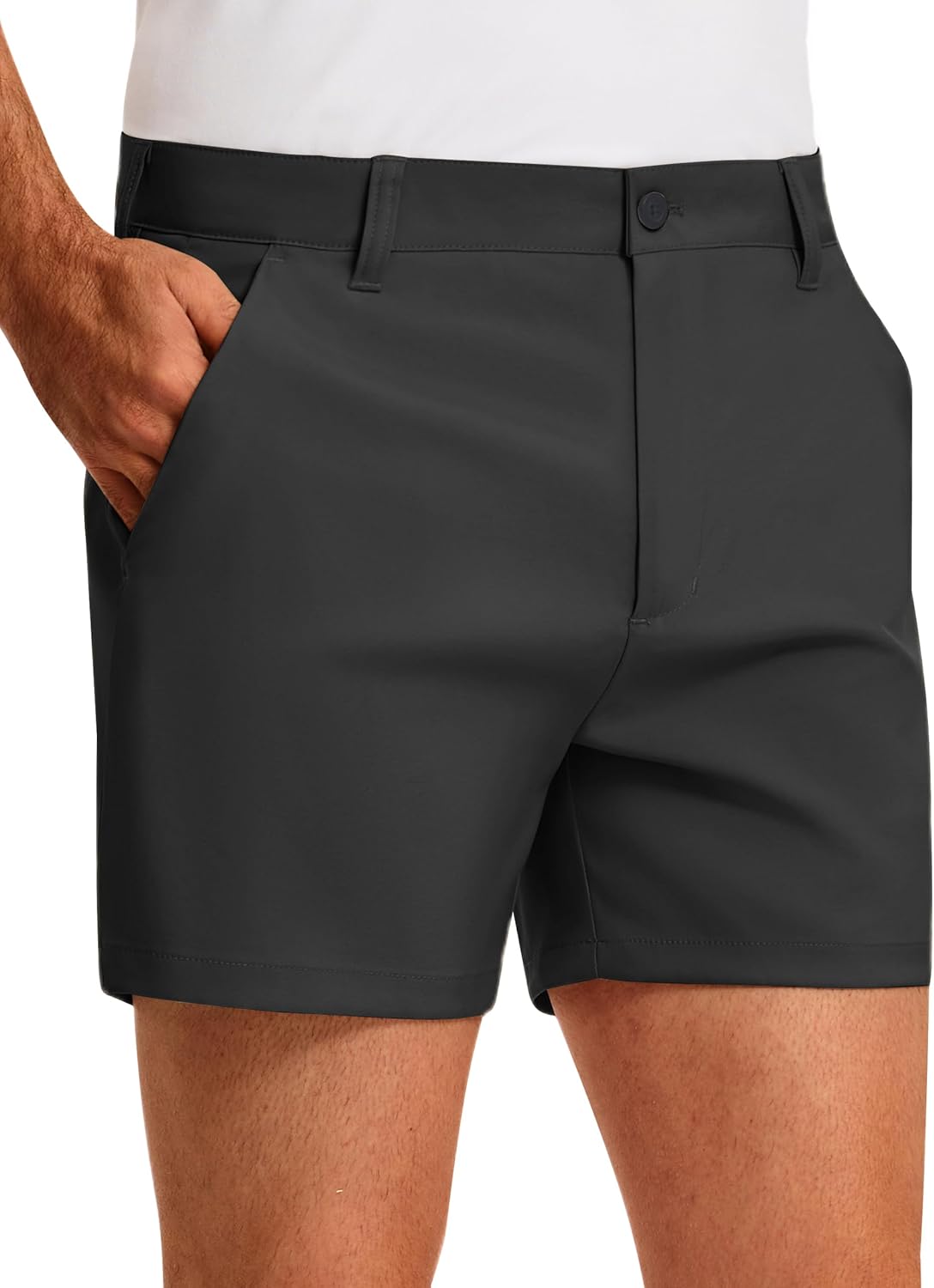
PULI Men s 5 Inch Inseam Golf Shorts are built for this scenario with a polyester-spandex blend (96% polyester, 4% spandex) and a practical pocket layout. The short inseam can improve airflow for players who overheat easily, and the stretch helps keep the fabric from feeling restrictive when you widen your stance or rotate aggressively. The design also includes five pockets, including a hidden zipper pocket intended for a phone, which helps you keep sweat-soaked items out of open pockets and reduces bouncing during fast walks between shots.
Walking 18 and Push Cart Days: Stability, Pocket Control, Less Fatigue

If you walk 18, the best golf shorts are the ones you stop noticing. That comes from a waistband that does not pinch when you breathe hard, and pockets that do not sway with every step. In other words, comfort is mechanical, not just fabric feel.
Prioritize these walking-specific features:
- Stable waistband with slight give (comfort under sweat)
- Pocket placement that stays vertical (less bounce)
- Secure closures for valuables (phone, wallet)
Also consider inseam length differently than you would for cart golf. A slightly longer inseam can reduce inner-thigh rub during long walks, especially if you have a narrow thigh gap or you sweat heavily. However, longer inseams can also trap heat, so you are balancing friction control against ventilation.
PULI Men s Golf Dress Shorts Flat Front Hybrid 7 Inch Lightweight Quick Dry are designed around the walking use case. The product description highlights a stretch waistband and a brushed tricot-lined waistband intended to help keep your shirt tucked through the swing. It also calls out a pocket system with two deep slant pockets plus a golf tee box, and two back pockets with zipper closures for security. For push cart rounds, those zip back pockets can be the difference between stable carry and constant adjustment.
Shop: PULI Men s Golf Dress Shorts Flat Front Hybrid 7 Inch Lightweight Quick Dry
Range Sessions and Practice Blocks: Mobility for the Swing Plane and Easy Care
Practice is where little fit issues become big annoyances. On the range, you repeat the same movement pattern 40 to 120 times, so any tightness at the hip crease or any waistband roll shows up fast. Your goal is consistent mobility through your full swing plane without needing to hike the shorts back into place.
Use this range-first test:
- Take five slow practice swings at 70% speed
- Pause at the top and feel hip and seat tension
- Finish and hold to see if the hem rides up
If the shorts shift, the pattern may be too tight in the seat or the waistband may be too rigid for your posture. Also, look for wrinkle resistance and machine-wash care if you practice often. Easy-care Performance Wear matters because golf shorts get salt-stained quickly in summer.
A shorter inseam, like a 5-inch style, can feel freer during speed training because there is less fabric to catch when you rotate and step. Meanwhile, a 7-inch hybrid short can be the better option if you want a cleaner chino silhouette for a quick stop at the clubhouse after practice.
Travel, Resort, and Off-Course Wear: Chino Look, Golf Performance
Travel golf exposes a different problem: you need one pair of shorts that works on course, at dinner, and in transit. That means you still want Moisture-Wicking and fast dry time, but you also care about how the fabric drapes and whether the pockets look clean when you sit.
A simple travel-ready framework:
- Fabric: quick-dry, not noisy
- Look: flat front, minimal branding
- Pockets: at least one secure pocket
- Care: machine wash, low fuss
If you are building a capsule wardrobe for a trip, aim for a neutral color that works with two polos and one casual shirt. Then choose inseam based on venue: resort golf often leans slightly longer and more classic, while very hot destinations reward shorter inseams for ventilation.
If you are also shopping Eco-Friendly Apparel, keep your sustainability check grounded in verifiable signals. One common label you will see is OEKO-TEX Certified. OEKO-TEX explains that STANDARD 100 is a label for textiles tested for harmful substances, and that every component (like threads and accessories) is tested against a list of harmful substances. According to OEKO-TEX, STANDARD 100 indicates textiles have been tested for harmful substances, with criteria based on intended use.
How to Choose Top Golf Shorts for Durability and Comfort in Hot Weather
Fabric blend: balance feel, dry time, and strength
Your best choice depends on your climate and how you sweat. Polyester-spandex blends often dry quickly and keep their shape, which supports Athleisure and Performance Wear use across golf, travel, and casual days.
Use this quick match:
- Very humid: prioritize faster dry time
- Very hot sun: prioritize breathability and light feel
- High abrasion (walking, practice): prioritize structure
Inseam length: heat relief versus coverage
Inseam is not just style. It changes airflow, inner-thigh friction, and how much fabric can bind during rotation.
Typical decision points:
- 5-inch: maximum airflow, freer feel
- 7-inch: balanced coverage and mobility
- 9-inch+: more coverage, more heat retention
Waistband design: stability under sweat
Sweat makes waistbands slip and shirts untuck. In hot weather golf shorts, look for some engineered give without feeling like elastic gym shorts.
If you walk, waistband comfort becomes endurance. A waistband that pinches at hole 6 is a distraction at hole 16. If you carry a belt, make sure belt loops are sturdy and the waistband does not fold.
Pocket system: secure phone and tees
Pocket bounce is a hidden fatigue cost, especially if you walk. Choose layouts that keep weight close to your body.
Key features to look for:
- Secure pocket (zipper or hidden)
- Deep front pockets
- Low-bulk back pockets
Decision table: scenario-based picks (not brand-specific)
| Scenario | Heat level | Walking level | Inseam target | Pocket priority |
|---|---|---|---|---|
| Humid summer rounds | High | Medium | 5-7 in | Hidden/zip phone |
| Walk 18 weekly | Medium | High | 7 in | Zip back pockets |
| Range practice blocks | Medium | Medium | 5-7 in | Minimal bounce |
| Travel and resort wear | Medium | Low | 7-9 in | Secure valuables |
Common Pitfalls to Avoid
Most bad purchases come from guessing based on thickness or from ignoring where friction actually happens.
- Assuming thicker equals tougher: In heat, thicker often means slower drying and more cling, which increases chafe.
- Ignoring waistband pinch points: If it pinches when you sit, it will pinch more when you walk and sweat.
- Overloading pockets while walking: Extra weight makes pockets swing, and you will tighten your gait to compensate.
- Buying only for the mirror: A clean front is good, but swing and stride comfort matter more by hole 12.
Conclusion
Top golf shorts for durability and comfort in hot weather come down to a few controllable choices: pick a fabric that dries fast, a cut that lets you rotate and stride, and a pocket system that stays stable when you walk. Then decide inseam length based on your personal trade-off between airflow and inner-thigh friction.
If you use the modules in this guide, you will stop guessing and start matching shorts to your real conditions: humidity, walking volume, and how much gear you carry. Once you find a pair that disappears on your body during a full round, buy that fit consistently and keep your care routine simple.
FAQ
How do I choose an inseam for hot-weather golf?
Choose the shortest inseam that does not ride up when you walk and rotate, because less fabric usually improves airflow and reduces cling. Most golfers land in the 5 to 7 inch range for peak summer conditions, depending on comfort and dress code. If you get inner-thigh chafing, a slightly longer inseam can reduce skin-on-skin friction, but only if the leg opening is not tight. If you feel restriction at address or during follow-through, that is a sign the inseam or cut is limiting hip rotation.
What fabric traits matter most for durability on the course?
Durability comes from a fabric that resists snags and abrasion while still recovering its shape after stretch. Look for structured weaves or tightly knit fabrics, because loose, soft fabrics can fuzz and catch on Velcro glove tabs. Pay attention to seams around pockets, belt loops, and the seat, because those areas see the most stress during squats and long walks. A small amount of spandex can help mobility, but the fabric should snap back instead of staying stretched.
What pocket features help during walking rounds?
Pockets help most when they keep items close to your body and prevent bounce. Deep front pockets reduce the chance of tees or a ball falling out when you sit on a cart seat or bend to mark a ball. At least one secure pocket, such as a zipper or hidden pocket, is ideal for a phone so it does not slide out during a fast walk. Back pockets that lay flat also reduce bunching under a belt, which matters more as sweat increases.
How can I reduce chafing in humid conditions?
Reduce chafing by minimizing wet fabric friction in the inner thigh and waistband zones. Choose shorts with a smooth inner feel, enough room through the thighs, and fast-drying fabric so sweat does not stay trapped. Keep pocket loads light, because extra weight makes fabric pull and rub as you walk. If you still chafe, consider using an anti-chafe balm on friction zones before tee time and avoid cotton underwear that stays wet.
Are moisture-wicking shorts always cooler in extreme heat?
Moisture-wicking shorts are not automatically cooler, because comfort depends on both moving sweat and allowing evaporation. In very humid conditions, evaporation slows, so a fabric can move moisture but still feel clammy if it cannot release heat and dry quickly. Fit matters too: a tight cut reduces airflow and increases friction, which can feel hotter even with the right fabric. For extreme heat, prioritize light weight, airflow, and a waistband that does not trap sweat.